
Last updated: May 2026
Key takeaways:
– Look for AI tells like warped hands, melting hair edges, mismatched mouth movements, and brochure-style writing with no real opinion.
– Skip unreliable AI detectors and use reverse image search tools like Google Lens or TinEye instead.
– Start around age 8, watch suspicious content together, and treat spotting fakes as a game rather than a fear lesson.
My 8-year-old showed me a video last week of a baby elephant doing backflips on a trampoline. He laughed. Then he looked up and said, “Wait, is this real?”
That’s the moment I knew I needed to teach him how to spot fake AI images, so
So here’s how to teach kids to spot AI-generated content in a way that actually sticks. Not a lecture for them, but a habit to build.
The problem isn’t AI. It’s the speed at which kids stop asking.
Kids absorb media faster than we do. They scroll, swipe, and trust. By the time a parent has even loaded the page, the kid has already watched four videos, formed two opinions, and shared one with a friend.
Most AI-generated content right now isn’t dangerous on its own. A goofy cat in a tuxedo is fine. The danger is the muscle that builds underneath all of it, the muscle that says, “if it’s on a screen, it’s probably true.”
That muscle is what we have to train. Early.
AI-generated content is any image, video, audio clip, or block of text created by a machine learning model rather than by a human with a camera, a microphone, or a keyboard. Tools like ChatGPT, Sora, Midjourney, and ElevenLabs can produce this stuff in seconds, and the quality keeps climbing.
What to actually look for (and teach your kid to look for)
Forget “trust your gut.”YouTube has trained kids’ gutse. Give them specifics.
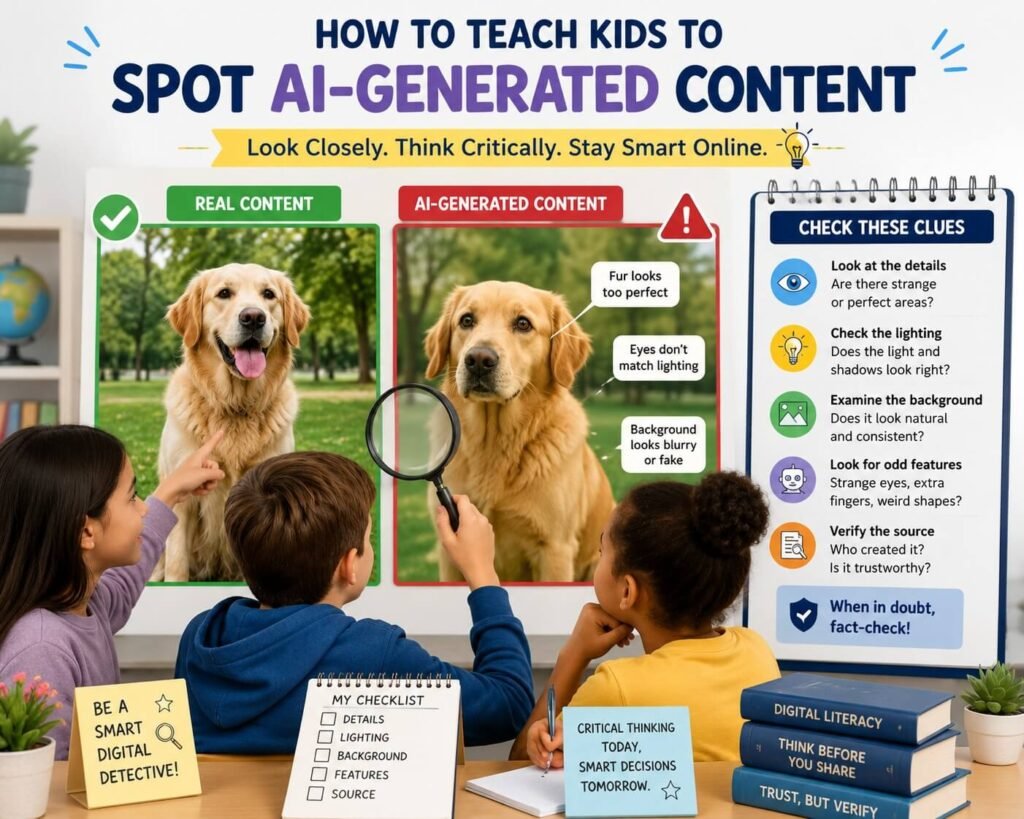
For images: Hands are still the giveaway. Count the fingers. Look at the jewelry, where the earrings meet the ear,andt the text onthe signs in the background. AI is famously bad at hands, weirdly bad at text, and clumsy with reflections. These are the basics of spotting AI-generated images, and once a kid knows them, they can’t unknow them.
For video: Watch the edges. Hair that melts into a hoodie. A background that ripples when a person walks past. Teeth that change shape between frames. A voice that’s a little too smooth, with no breath in the wrong places. Those are the deepfake detection signs that actually matter day to day.
For text: Look for the writing that sounds like a brochure. Lots of words, no opinion. Long sentences that say nothing. The phrase “in today’s fast-paced world” appearing anywhere, ever.
This is the part where kids actually get into it, by the way. Spotting AI is a game. Make it one.
Build the habit with three questions
Here’s what I run with my son before they trust anything. Three questions, in order. They take about ten seconds.
1. Who made this? A real person? A real account? A news source you recognize, or a username with a string of numbers?
2. Can I find it somewhere else? If a video shows a real event, other people will have filmed it too. One source, one angle, one upload usually means trouble.
3. Does it want me to feel something fast? AI misinformation for children almost always pushes a strong emotion, anger, fear, awe, before you’ve had a chance to think.
That third one is the most important. The whole reason fake content gets shared is that it bypasses the brain. Teach your kid to notice the feeling, then pause.
You’ll know the lesson is landing when your kid pauses on their own. That’s the goal. Not paranoia, just a half-second of friction between seeing and believing.
Tools that help, and tools that don’t
There are AI-detection tools out there. Most of them are unreliable, especially for text. Teachers have learned this the hard way over the last two years, and the research keeps backing it up: detectors flag real student writing as AI and miss actual AI all the time.
So I don’t lean on detection software with kids. Instead, I lean on reverse image search for kids. Google Lens and TinEye both let a kid drop in any image and see where else it appears on the internet. If a “recent” photo first showed up six months ago in a different context, that’s the answer.
For video, the best tool is honestly just slowing down. Pausing on a frame. Looking at the corners.
For text, read it out loud. AI writing has a rhythm. Once a kid hears it twice, they’ll spot it for the rest of their life.
Where this fits in the bigger picture
Media literacy used to be a once-a-year class in school. Now AI media literacy is a daily survival skill. Kids growing up right now will see more AI-generated content before they turn 13 than most adults will see in a decade.
Spotting fake content is part of it, but the bigger piece is teaching kids to use these tools as builders instead of just consumers. A kid who’s used ChatGPT to draft a sales page for her dog-treat business knows what AI writing sounds like.
She’s seen the patterns AI writes with and can’t unsee them.
That’s what I want for my own son, and for yours. Not to fear the technology, but to be familiar with it. The two look very different from the inside.
If you want a broader frame on this, our post on what AI literacy actually means for kids goes deeper into the skills that matter most.
Questions parents ask
Start at 8, or whenever your kid begins watching videos or reading articles unsupervised. Kids ages 8-12 are the prime window because they’re old enough to think critically but young enough to build the habit before bad assumptions set in.
No, not reliably. AI text detectors have been shown to be unreliable, frequently flagging human writing as AI-generated, and image detectors get fooled by simple edits like cropping or filtering. Reverse image search through Google Lens or TinEye is more useful for parents than any dedicated detector.
Look for three things: warped backgrounds when people move, mouths that don’t quite match the audio, and unnatural eye movement or blinking patterns. If two of those three show up, it’s almost certainly synthetic.
No. Blocking it builds curiosity without building skill. A better approach ito watchng it together anpointng out the tells, so your kid learns to spot fakes in real timrather thanof avoiding them.
The pause. Before sharing, before reacting, before believing, ten seconds of “who made this and why.” That one habit prevents most of the problems AI content creates for kids.