
Last Updated: April 2026
Can a Child Have a Business? If your child has ever tried to sell lemonade on the sidewalk, make bracelets for their classmates, or asked you how companies make money, you might already have a little entrepreneur on your hands. But can a child actually have a business? Can a kid really run one? And if so, where do you even start?
The answer might surprise you — and it might just change how you think about your child’s future.
Can a Child Have a Business?
Yes, a child can absolutely have a business. There is no minimum age requirement for having a business idea, creating a product, or selling something of value. Children around the world are already doing it — writing and publishing books, selling handmade crafts, offering services in their neighborhoods, and even building audiences online.
From a legal standpoint, minors cannot sign contracts or formally register a business on their own in most countries, including the United States. That is where parents or guardians come in. An adult can register the business on behalf of the child, open a bank account, handle any legal paperwork, and act as the responsible party while the child runs the day-to-day operations.
But make no mistake — the business can still be the child’s. The idea, the product, the hustle, the decisions. All of it can belong to them. The parent is the legal backbone, not the boss.
Some of the most inspiring young entrepreneurs in recent years started their businesses between the ages of 7 and 12. An 8-year-old who writes and self-publishes a book on Amazon is running a real business. A 10-year-old who bakes and sells cookies at a local market is a real entrepreneur. Age is not the barrier most people think it is.
Can a Kid Run a Business?
Not only can a kid run a business — in many ways, kids are uniquely positioned to do it well.
Children are naturally creative. They have not yet been told what is impossible, so they think bigger and more freely than most adults. They are also closer to their own market than anyone else. A 9-year-old who creates a product for other kids understands that customer better than any adult ever could.
Running a business teaches kids skills that no classroom subject covers on its own. When a child runs a business, even a small one, they learn how to manage money, communicate with customers, solve problems under pressure, handle rejection, and keep going anyway. These are life skills that will serve them for decades.
Of course, kids need guidance and support. A parent or mentor who helps them understand the basics — pricing, profit, marketing, customer service — makes all the difference. But the child should be the one making decisions, learning from mistakes, and experiencing the real rewards of their own work. That ownership is what makes the experience transformational.
The biggest thing standing between most kids and a business is simply someone telling them it is possible and showing them how.
What Is a Good Business for a Kid to Start?
The best business for a kid to start is one that connects to something they already love. Passion is the fuel that keeps young entrepreneurs going when things get hard — and things always get a little hard.
Here are some of the best business ideas for kids, organized by type:
Creative and Handmade
- Selling handmade jewelry, bookmarks, or artwork
- Writing and self-publishing a book or activity book on Amazon KDP
- Creating and selling digital drawings or designs
- Making and selling greeting cards or stickers
Service Based
- Pet sitting or dog walking in the neighborhood
- Lawn care, gardening, or car washing
- Tutoring younger kids in a subject they are strong in
- Helping neighbors with tech, like setting up devices or teaching them to use apps
Food and Baking
- Selling homemade baked goods at local markets or to neighbors
- Creating a specialty lemonade or snack stand
- Making and selling homemade jams, sauces, or treats
Online and Digital
- Starting a YouTube channel around a hobby or skill
- Selling printables or worksheets on Etsy
- Creating a newsletter or blog around a topic they love
Reselling
- Buying items at thrift stores and reselling them online
- Flipping toys, books, or collectibles on platforms like eBay
The key is to start small, start simple, and start with what they have. A great kids business does not need a big investment. In fact, some of the best businesses kids can start require $50 or less to launch.
How to Start a Kids Business
Starting a business as a kid does not have to be complicated. Here is a simple step-by-step process that works for children ages 8 and up:
Step 1: Find the Idea
Start with what your child loves, what they are good at, and what people around them might actually pay for. The intersection of those three things is where the best business ideas live. Encourage them to brainstorm without limits first, then narrow down together.
Step 2: Define the Product or Service
Once they have an idea, get specific. What exactly are they selling? What does it look like, cost to make, and how long does it take to produce? This is where kids start thinking like real business owners.
Step 3: Know the Customer
Who is going to buy this? Neighbors? Kids at school? People online? Knowing the target customer helps with everything — pricing, marketing, and where to sell. This is called the target market, and even young kids can understand it quickly.
Step 4: Set a Price
This is one of the most important lessons in kids entrepreneurship. The price needs to cover the cost of materials, leave room for profit, and still feel fair to the customer. Walk your child through the math. It is one of the best real-world finance lessons they will ever get.
Step 5: Make a Simple Plan
A business plan does not have to be a long document. For kids, it can be a single page that answers: What am I selling? Who am I selling to? How much does it cost to make? How much will I charge? Where will I sell it? That is a real business plan.
Step 6: Start Small and Sell
The best way to learn is to start. Help your child make their first few products, set up their first selling spot — whether that is a table in the neighborhood, an Etsy shop, or an Amazon listing — and make their first sale. That first sale is a moment they will never forget.
Step 7: Learn, Adjust, and Grow
Every business hits bumps. Maybe the price is too high. Maybe the product needs improving. Maybe a different location would work better. Teach your child to treat every challenge as information, not failure. This mindset is what separates entrepreneurs who succeed from those who give up.
The Right Time to Start Is Now
There is no perfect age to start a business. There is no perfect idea, no perfect product, and no perfect moment. The kids who go on to become confident, financially capable, creative adults are the ones who started doing — even imperfectly — while everyone else was waiting.
At Livingston Global Academy, we believe every child has the potential to be an entrepreneur. Our kids business classes are designed to give children ages 8 to 12 the real tools they need — from brainstorming and business planning to marketing, finances, and pitching their ideas with confidence.
If your child is ready to start, we are ready to help them.
Explore our kids business classes at Livingston Global Academy and give your child the skills to build something real.
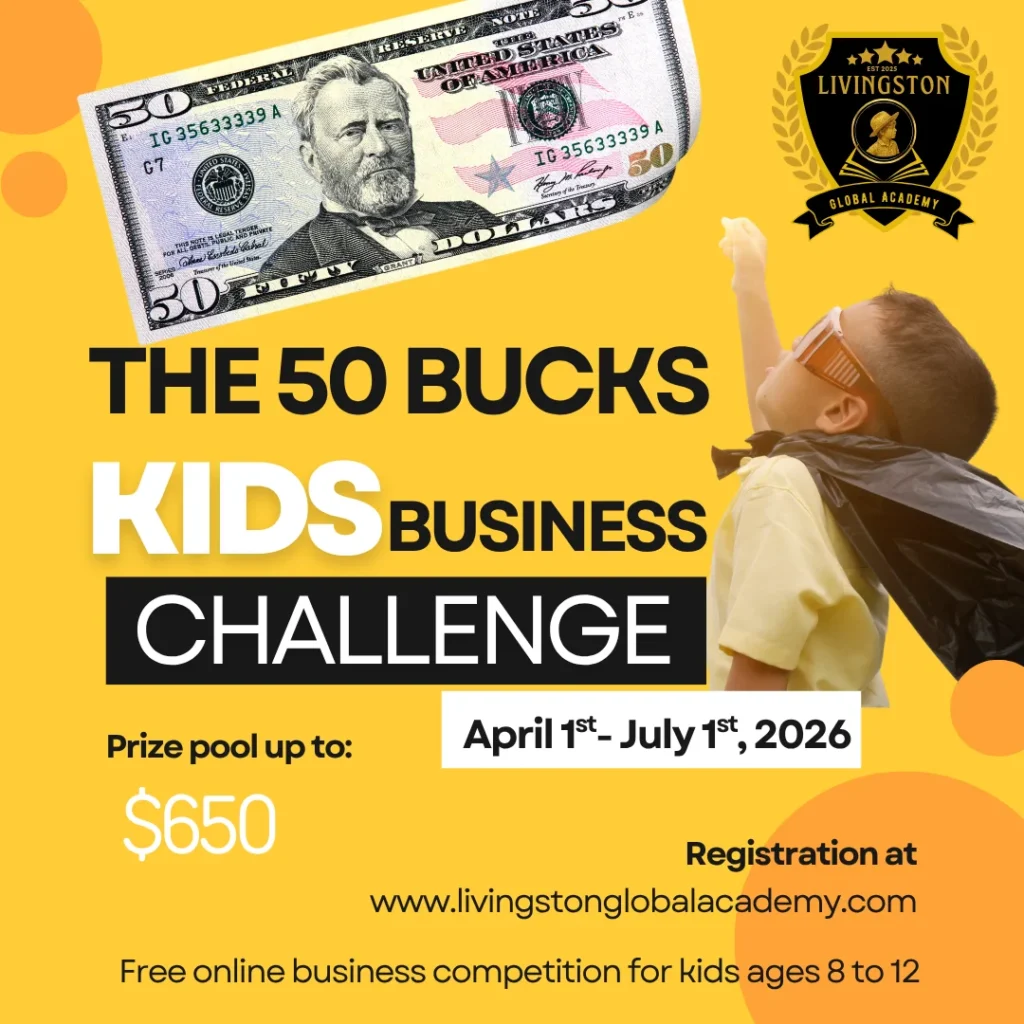
Check out the $50 Bucks Kids Business Challenge — a free online competition where kids pitch their business idea and win real prizes including cash to start their business.
kids business, can a child have a business, can a kid run a business, business ideas for kids, how to start a kids business, entrepreneurship for kids, kids entrepreneur, financial literacy for kids, online business classes for kids, Livingston Global Academy